

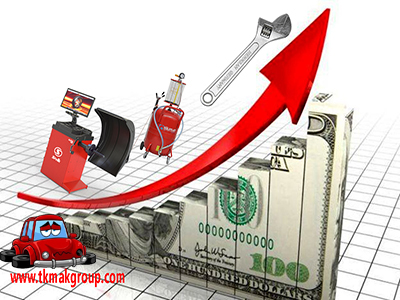
The automotive service industry, including repair shops and auto services, is a vital sector of the Iranian economy that is directly related to the welfare of citizens and the performance of the automobile market. These businesses depend on specialized equipment, precision tools, and spare parts to provide quality services. On the other hand, a large part of this equipment and tools is imported from abroad or is related to imported parts and technologies. In such circumstances, an increase in the exchange rate can have profound effects on the costs, pricing of services, and the competitiveness of these businesses.
1. Increase in the cost of importing equipment and tools
A large part of specialized repair shop tools, including diagnostic devices, hydraulic tools, test and measurement equipment, jacks, compressors, etc., are imported to Iran from other countries. With an increase in the exchange rate:
The cost of purchasing this equipment increases.
Many repair shops lose the financial capacity necessary to procure new equipment.
Used and worn-out equipment that was previously replaceable is more likely to remain in business.
Rising import costs will force businesses to switch to lower-quality or non-specialized equipment, which can reduce service quality in the long run.
2. Rising prices for consumables
Consumables such as wrenches, wrenches, brake pads, filters, and spare parts that are highly dependent on foreign currency also become more expensive with an increase in exchange rates. This leads to:
Increasing repair costs for customers
Reducing repair shops’ profit margins if the cost is not fully passed on to the customer
Reducing customer demand for non-essential services
For example, specialized tools for new cars or luxury brands may become out of reach for many average repair shops due to an increase in exchange rates.
3. Impact on service prices and market competition
Currency fluctuations cause an increase in overall operating costs, which ultimately manifests itself in the form of an increase in the price of repair and service services. This is the result of several factors:
Increased cost of parts and tools
Increased cost of equipment maintenance and repair
Increased cost of labor (due to increased inflation)
This increase in service prices causes a change in consumer behavior. Customers may:
Delay some services
Look for cheaper or informal options
Resort to performing basic repairs themselves
Competition between repair shops to attract customers in such conditions increases sharply and smaller firms may exit the market.
4. Educational and technological challenges
Modern repair shop equipment requires specialized training. With an increase in currency value:
The cost of training personnel also increases.
Repair shops may refrain from updating their technical knowledge.
New technologies, such as complex electronic systems in cars, are becoming less accessible, and repair shops are having difficulty adapting to new market needs.
This not only reduces the quality of service, but can also lead to a technical gap between equipped and unequipped repair shops in the long run.
5. Solutions and Suggestions
To reduce the negative effects of the exchange rate increase, the following solutions can be suggested:
A. Strengthening domestic production of equipment:
Creating support platforms for domestic manufacturers of repair shop tools can reduce dependence on imports.
B. Forming joint procurement unions:
Repair shops can reduce the costs of purchasing tools and parts by forming joint purchasing groups.
C. Using digital technologies:
Using repair shop management software, online parts sales, and virtual training can help reduce costs and increase productivity.
D. Government Supportive Policies:
Providing foreign exchange facilities, tax exemptions, or encouraging investment in the production of specialized equipment can reduce economic pressure.
As a result, the increase in the exchange rate in Iran is not just a financial issue; it also has widespread effects on service businesses such as repair shops and auto services. These effects can lead to a change in the structure of the automotive service market in the short term in the form of increased costs, and in the long term, they can lead to a change in the structure of the automotive service market. By adopting appropriate solutions and utilizing domestic capacities, these challenges can be turned into opportunities and lead the automotive service industry towards greater sustainability and competitiveness.
TK Mak Industrial Group is an importer and distributor of repair shop, auto service, and workshop equipment.
نظرات کاربران (0)
هنوز نظری ثبت نشده است. اولین نفر باشید!